

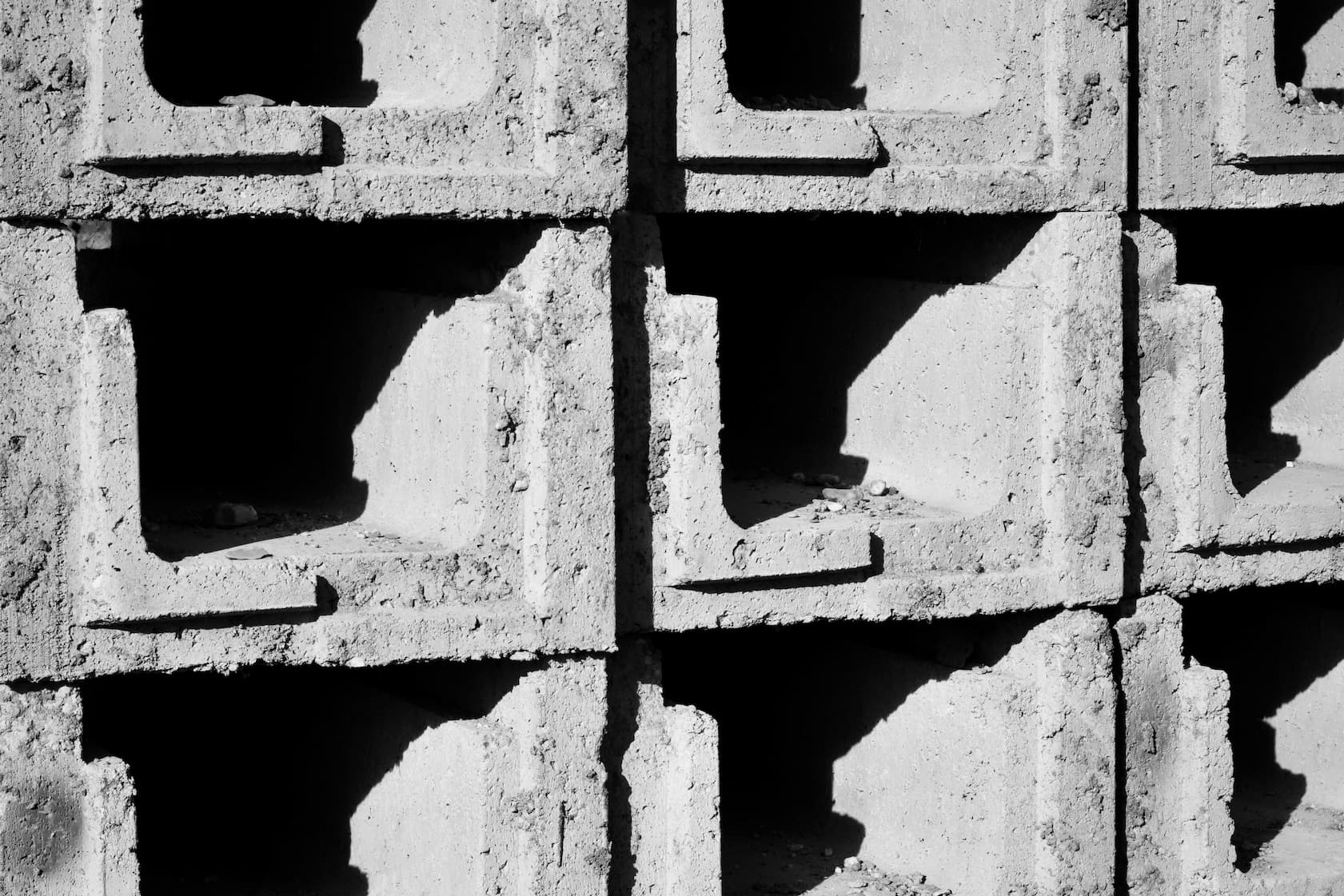
While many may be familiar with dense concrete blocks for fortifying structures, breeze blocks provide many benefits to a variety of decorative and load-bearing applications.
But what parameters make these blocks different, and how can you tell which block is best suited for you?
What Are Dense Concrete Blocks?
Often referred to as either solid dense or high density blocks, dense concrete blocks are made using natural aggregates, like gravel and limestone.
Usually, they range between 1,850 and 2,100 kg/m³ in terms of density and can be purchased in solid, cellular, and hollow formats.
The standard face size across the UK is 440 x 215mm, but bear in mind that thickness can vary from 100mm to 215mm; this depends on the structural demand.
A standard 100mm dense solid block weighs around 20kg, something else to factor in when you’re mapping out labour requirements and manual handling.
Dense Block Advantages
Dense blocks are commonly chosen because of their supreme sound insulation for party walls, separating walls between homes, and general jobs where acoustic performance has been specified. Their mass is the key factor here: the heavier the block, the more sound energy it absorbs rather than transmitting.
They also provide outstanding fire resistance. Dense aggregate blocks are regularly specified for compartment walls and firebreak walls in both residential and commercial builds.
For Northamptonshire projects involving retaining structures around sloped plots or garden terracing, dense blocks are the reliable, proven choice.
What Are Breeze Blocks?
Breeze blocks got the name when breeze was used to make blocks. Even today, constructors still use that term, but what they are actually referring to are lighter concrete blocks.
These blocks are manufactured using a combination of aggregates, including ash, lightweight expanded clay, or other materials that reduce density without really compromising structural performance. They normally sit in the 1,300 to 1,600 kg/m³ density range with compressive strengths between 3.6N/mm² and 10.4N/mm².
Advantages of Breeze Blocks
The key benefit of these blocks is their medium to lighter weight, something that helps faster laying rates and is easier for groundspeople and bricklayers to work with.
Breeze blocks also offer better thermal insulation performance than dense blocks. Where energy efficiency is a priority in a wall build-up, lighter blocks carry better lambda values and contribute more meaningfully to meeting Part L of the building regulations.
They take plaster and render finishes well, making them a practical choice for internal walls in residential extensions and new builds where a smooth finished surface is needed.
Comparison of Dense Blocks vs Breeze Blocks
Factor | Dense Concrete Blocks | Breeze Blocks (Lighter Blocks) |
Density | 1,850 to 2,100 kg/m³ | 1,300 to 1,600 kg/m³ |
Compressive Strength | 7.3 to 22.5 N/mm² | 3.6 to 10.4 N/mm² |
Typical Weight per 100mm | 20kg | 10 to 14kg |
Sound Insulation | Excellent | Moderate |
Thermal Insulation | Lower | Better |
Fire Resistance | Excellent | Good |
Below-DPC Suitability | Yes (recommended) | With appropriate specification |
Waterproofing | High resistance | More porous, requires treatment |
Cost (per block approximately) | £4 | £2.50 |
Ease of Handling | Heavier, therefore slower | Lighter, so faster laying |
Typical Applications | Foundations, retaining walls, party walls, below ground | Inner leaf cavity walls, partitions, extensions, beam-and-block fill |
Should I Use Dense Blocks or Breeze Blocks?
Below ground, for foundations, trench fill, and any blockwork under the damp proof course, dense blocks are the correct specification. Their low porosity and high compressive strength resist ground moisture effectively, and in the Northamptonshire clay belt, seasonal movement is a factor, so you want that ground reliability.
For load-bearing external walls above DPC, dense blocks are the better option because of the compressive strength they possess, deployed for things like commercial builds, multi-storey residential, or structures carrying significant point loads. Party walls between semis and terraced properties almost always require dense blocks so they meet Part E acoustic standards.
Lightweight blocks come into their own as the inner leaf of a cavity wall, internal partitions, and outbuildings or garden walls; they’re lighter, faster to lay, and cost-effective, provided the base course is always laid on dense blocks below ground.
Source Your Blocks from Joseph Parr Northants
Here at Joseph Parr Northants, we stock a range of blocks, and invite you to get in touch if you need advice.